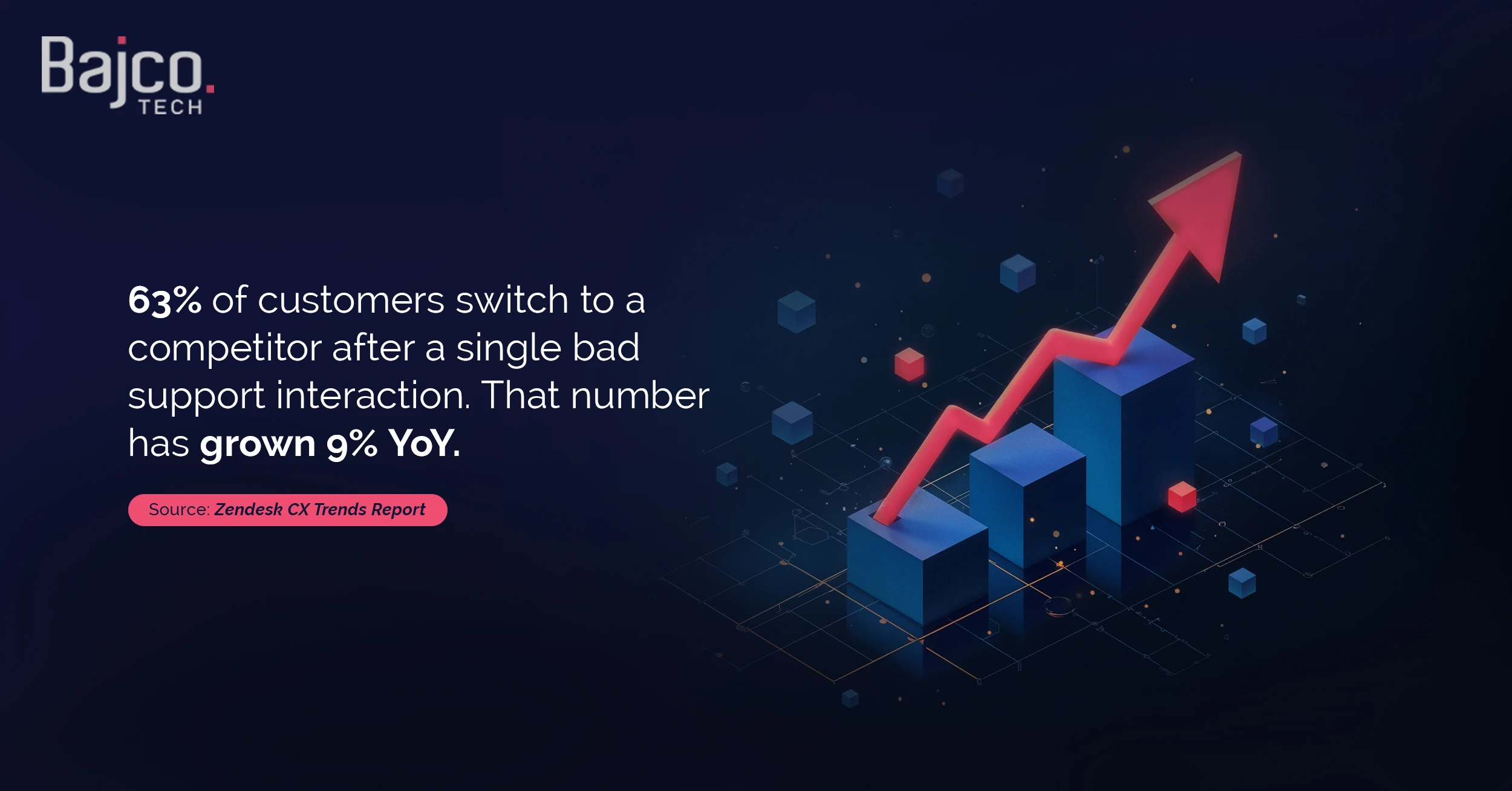
Customer patience has a shorter fuse than it used to. According to Zendesk’s CX Trends Report, 63% of consumers will switch to a competitor after just one bad experience, and that number has grown 9% year on year. Not two bad experiences. Not a pattern of neglect. One interaction.
That’s not a margin-of-error problem but a structural one.
And yet most support teams are still running the same playbook they were using five years ago, stretched across email, live chat, phone, social DMs, and messaging apps, often on separate tools that don’t talk to each other. Every time a customer reaches an agent, that agent starts from zero: no history, no context, no idea this person already called yesterday. The customer repeats themselves. The agent pieces things together manually. Somewhere in that gap, the relationship frays.
Why Reactive Support Is Breaking Down
Reactive support was built on a simple premise: a customer has a problem, they reach out, an agent responds. It worked when volume was manageable, channels were few, and expectations were low. None of those conditions hold anymore.
The operational cost of the current model is easy to underestimate. Manual ticket routing creates bottlenecks. Repetitive queries consume senior agent time. Context gets lost in handoffs. Agents burn out cycling through the same ten questions while genuinely complex problems sit waiting.
The result: slower resolution, lower customer satisfaction, higher churn, and a team that’s both exhausted and underutilised at the same time.
The frustrating part is that most of the damage happens invisibly. No single failure is catastrophic. It’s the accumulation: the customer who had to explain their situation multiple times, the ticket that sat in the wrong queue for numerous days, the agent who gave inconsistent information because they didn’t have access to the previous conversation. This quietly erodes trust.
What AI-Powered Support Actually Does
The phrase gets used loosely enough that it’s started to lose meaning. AI-powered support isn’t a chatbot that asks “Have you tried turning it off and on again?” It’s a structural rethink of how work moves through a support operation and what humans need to be doing at each stage.
Gartner projects that by 2029, agentic AI will autonomously resolve 80% of common customer service issues, cutting operational costs by 30%.
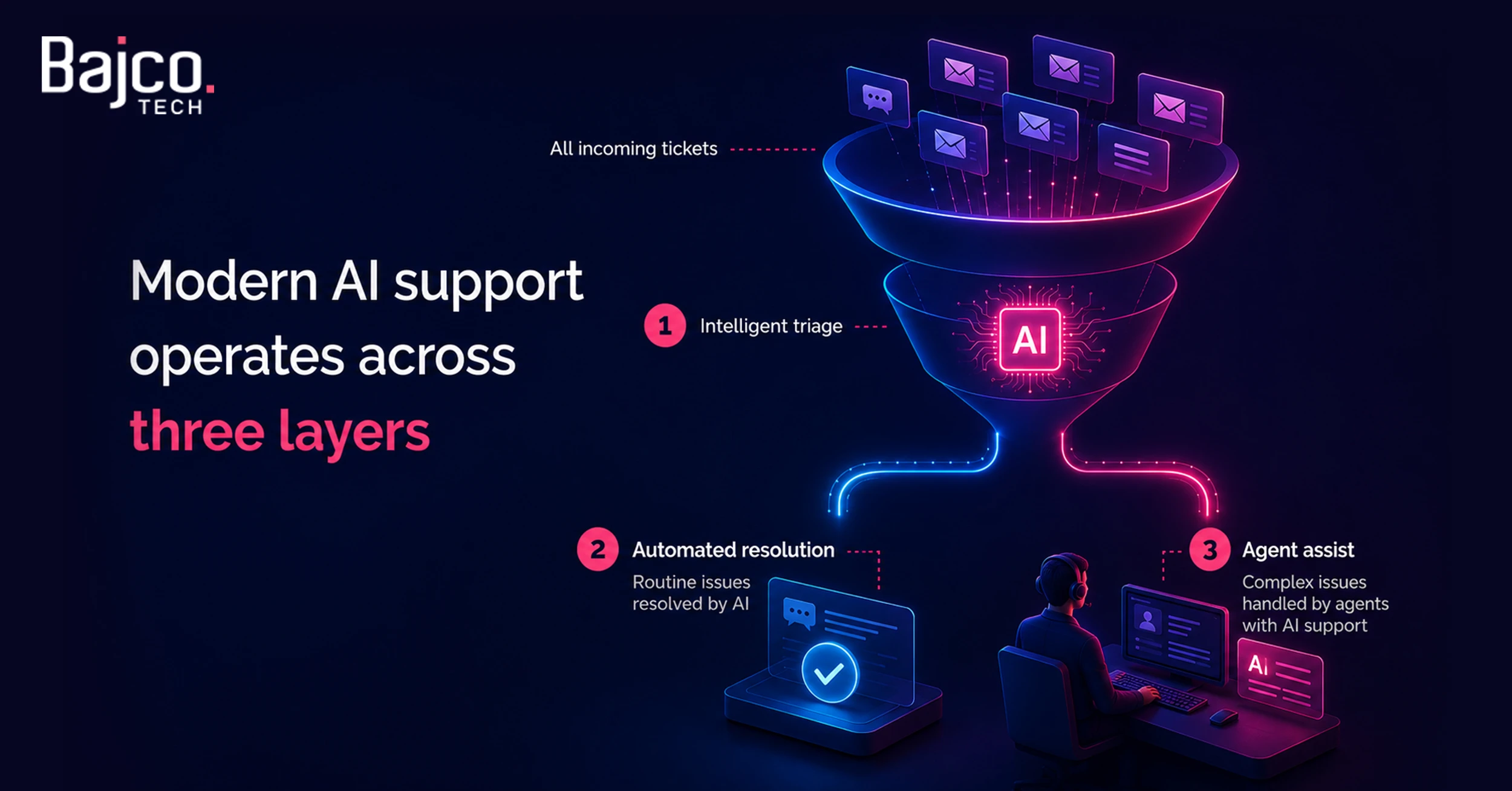
Modern AI support operates across three layers:
Intelligent Triage
AI reads every incoming ticket and routes it automatically based on intent, urgency, language, and customer history. The right ticket gets to the right team without anyone manually sorting through a queue. SLAs stop getting missed because something sat in the wrong inbox.
Automated Resolution
Agent Assist
For conversations that do reach a human, AI works alongside the agent in real time. It surfaces relevant knowledge base articles, suggests response language, summarises the customer’s prior history, and flags when sentiment is turning negative. Agents spend less time searching for information and more time using it.
These three layers change what support is capable of.
What the Results Look Like in Practice
Esusu, a fintech company handling around 10,000 tickets per month, deployed Zendesk AI agents and automated 64% of their email interactions from day one. First reply time dropped by 64%. Full resolution time fell by 34%. Customer satisfaction scores went up by 10 points. They did not hire more agents to achieve this. They changed how the work gets done.
Vimeo used Zendesk AI Agents to manage millions of customer interactions and increased agent productivity by 36%, giving their team back the capacity to focus on complex, relationship-driven issues instead of routine volume.
At the broader level, Zendesk’s 2025 CX Trends Report found that companies leading on AI-driven support report 33% higher customer acquisition rates, 22% higher retention, and 49% higher cross-sell revenue compared to businesses still operating on traditional support models.
The gap between those two groups is only getting wider.
The Human-AI Balance — The Part Most Get Wrong
A lot of businesses hesitate on AI because they assume it means replacing their support team. It doesn’t. The teams getting the best results are not the ones that automated everything. They’re the ones that were deliberate about what AI should handle and what humans should own.
AI is well suited to volume, speed, and consistency. It doesn’t get tired, doesn’t lose context between conversations, and doesn’t need to be trained on the same question twice.
Humans are well suited to complexity, judgment, and empathy. When a customer is frustrated, when a situation doesn’t fit any script, when a relationship needs to be rebuilt, those moments need a person.
When you get that balance right, agents shift from being ticket processors to being relationship managers. Job quality improves. Turnover drops. And customers can feel the difference.
Why Platform Choice Is a Strategic Decision
The technology is only part of the equation. Plenty of teams have bought the right platform and still ended up with a fragmented implementation: AI bolted onto old workflows, agents who don’t trust the tooling, and results that never materialise.
The platform matters, but so does how you get there.
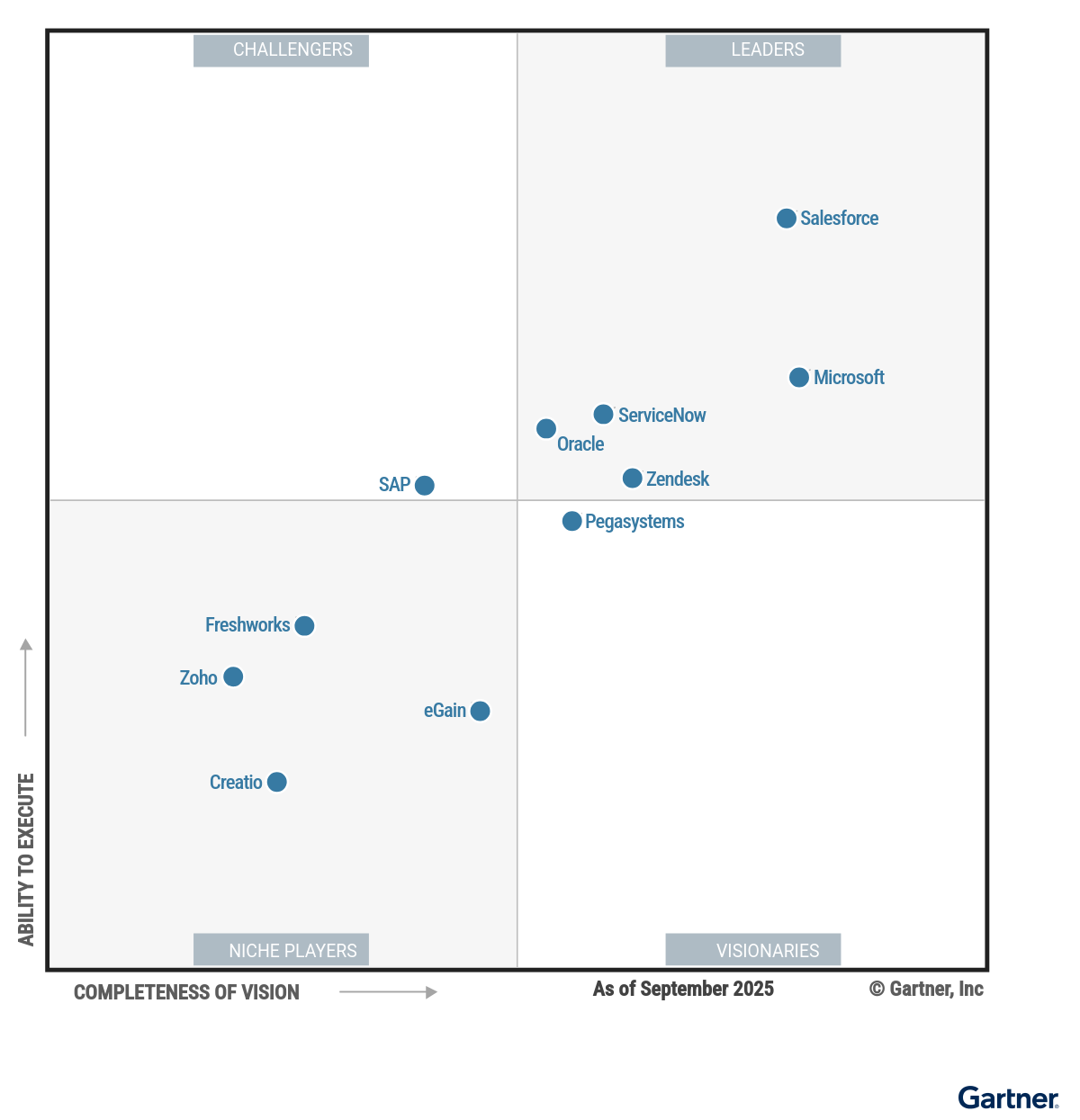
Zendesk was named a Leader in the 2025 Gartner Magic Quadrant for the CRM Customer Engagement Center, because of how deeply AI is built into the core of the product. The AI agents, agent copilot, intelligent triage, and generative search aren’t integrations. They’re native, and they improve automatically with every resolved interaction.
In practice, that means agents work from a single unified workspace where every channel (email, chat, voice, WhatsApp, social) feeds into one view of the customer. No more context-switching. No more asking a customer to repeat their order number. And as ticket volume grows, AI absorbs the increase without a proportional headcount increase.
With over 1,800 integrations, Zendesk also connects to the tools most teams are already using, whether that’s a CRM, an e-commerce platform, or an internal knowledge base, without requiring a full infrastructure overhaul.
Choosing a support platform isn’t an IT decision. It’s a decision about the ceiling on what your support operation can truly become.
Getting the Transition Right
Most support transformations stall not at the technology decision, but at implementation. What to automate, what to leave with humans, how to configure workflows that match how your team operates: these aren’t questions the platform answers for you.
That’s where Bajco Technologies comes in. As an official Zendesk Implementation Partner, Bajco works with businesses to design environments built around real outcomes, not just a functional setup, but one that’s scoped to your specific support challenges, integrated with your existing stack, and built to scale as your operation evolves.
If the self-assessment above raised questions, you don’t have answers to yet, that’s exactly the conversation to start there.