Artificial intelligence has moved from the edges of restaurant operations into the center of how customers order, how calls are handled, and how operators manage their busiest hours.
For quick-service restaurant (QSR) operators, understanding this shift is no longer optional. It’s the difference between leading the next era of fast food or scrambling to catch up.
This guide breaks down what AI in QSR order taking actually looks like today, what the data shows, and how operators can act on it with intention.
Why AI Has Become Central to QSR Operations in 2026
The restaurant industry has always operated on thin margins and high volumes. Every second of wait time, every missed call, and every order error has a real dollar cost. AI is solving exactly these problems, and the market is responding accordingly.
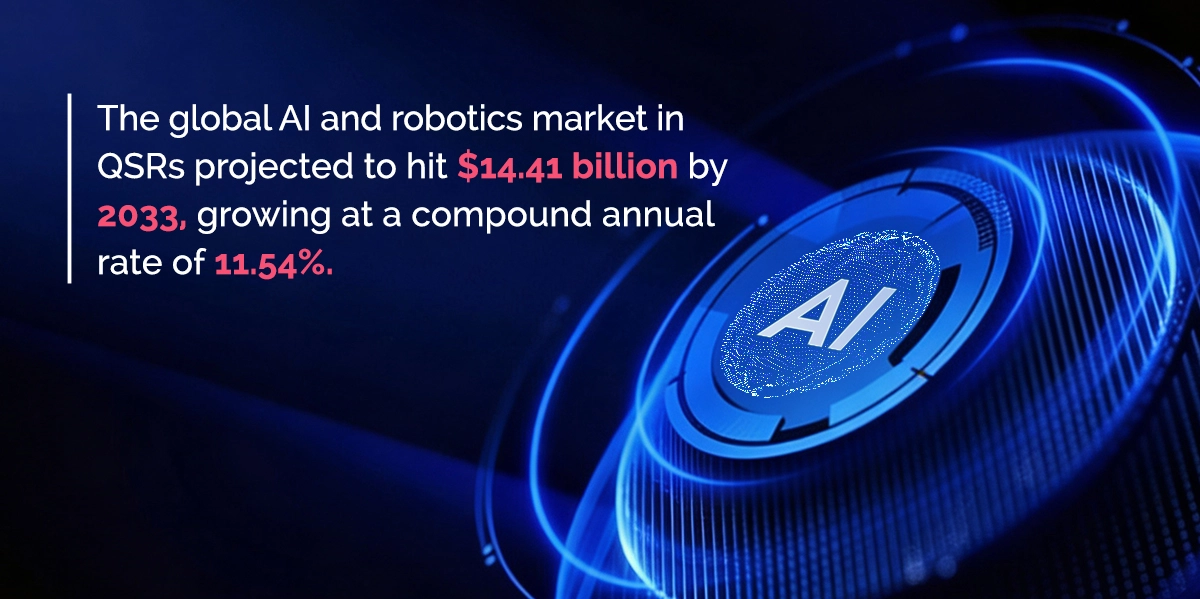
This isn’t a speculative investment; it reflects operators across the world actively deploying AI to protect margins, manage labor, and improve the guest experience.
The operator sentiment mirrors that investment. According to a report, 54% of restaurant operators expect AI to become a staple in their business within the next three years, with nearly half planning to adopt it within the year. And on the broader business side, CCW Digital research shows that 99% of organizations are maintaining or increasing their AI investments in 2026.
The turning point was this: AI stopped being a pilot-stage experiment and became an operating model. Industry analysts describe 2026 as the year AI transitions from “experimental novelty to operational necessity,” driven by persistent labor shortages, tightening margins, and customers who expect faster, more personalized service at every touchpoint.
The AI-First vs. AI-Only Distinction That Every Operator Needs to Understand
Before deploying any restaurant AI solution, operators need to understand a critical strategic distinction: AI-first is not the same as AI-only. Confusing the two is one of the most common and costly mistakes in technology adoption.
An AI-first model means technology handles the routine, high-volume, transactional layer of customer interaction: taking a standard drive-through order, confirming customizations, processing a payment, and routing an inbound call to the right destination. Human team members are then freed to do what they’re uniquely equipped for: resolving complex situations, showing empathy, and building real connections with guests.
An AI-only approach, by contrast, removes people from the equation entirely. And customers notice. Research shows that 60% of consumers worry they will have a harder time reaching a human as AI adoption increases, and 91% feel companies are pushing them toward self-service. When automation is deployed without thoughtful human escalation, trust erodes quickly.
The AI-first framework solves for both efficiency and trust. Automation handles the volume. Humans handle the moments that matter. The result is a faster, more consistent experience that still feels personal, which is exactly what QSR guests are looking for.
What the Numbers Say: AI Performance in QSR Environments
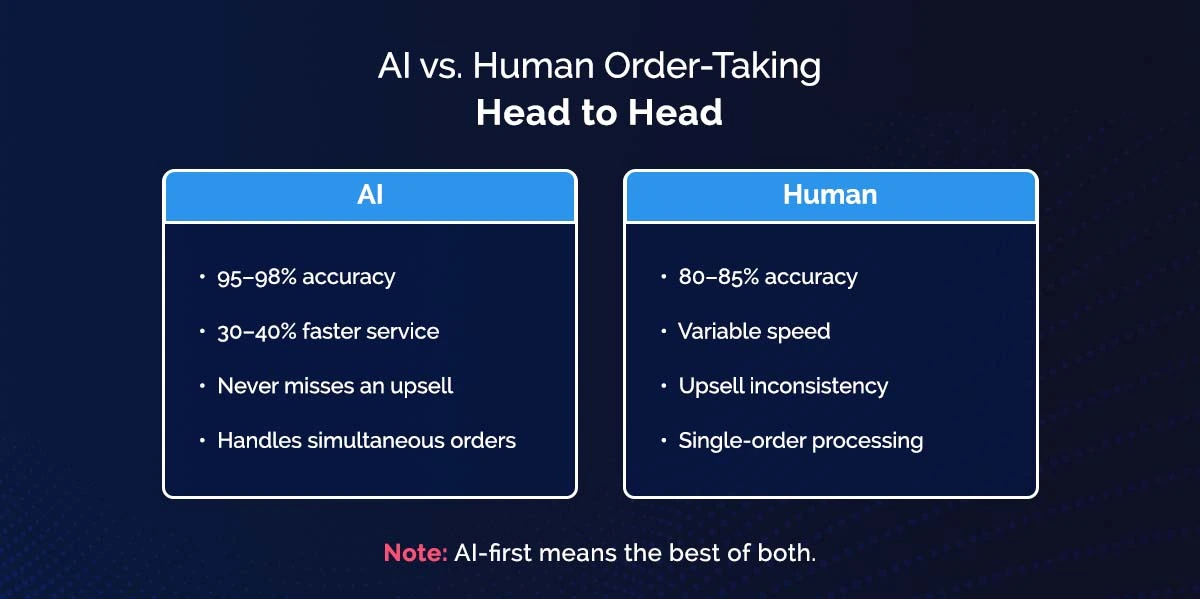
The data on AI order taking in restaurants is now robust enough to be genuinely instructive. Here’s what real-world deployments are showing:
Order Accuracy: AI voice systems achieve 95–98% accuracy under controlled conditions, compared to 80–85% for human order-takers during peak hours. Wendy’s FreshAI, developed in partnership with Google Cloud and deployed across 500–600 U.S. locations, has demonstrated 99% order accuracy in its reporting. Hi Auto, deployed across approximately 1,000 QSR drive-through stores, reports 96% accuracy and 93%+ order completion rates at scale.
Speed: At Taco Bell, voice AI cut total drive-through time by 1 minute and 54 seconds compared to the 2024 benchmark, even with more cars in the line. Wendy’s brought its total service time well below the QSR average. Across the industry, restaurants using AI voice bots report 30–40% shorter ordering times.
Labor Impact: Automating phone and drive-through orders can cut direct labor costs associated with order taking by 15–25%, while freeing employees for higher-value work. At Taco Bell, Omilia’s conversational AI achieves more than 90% successful order containment, meaning nine out of ten orders are completed without any human intervention needed.
Revenue: AI-driven upselling increases average order values by 20–40% because the system never forgets to suggest a side, an upgrade, or a seasonal add-on. It also captures calls that humans miss: with 60% of customers hanging up after one minute on hold, AI phone answering systems recover significant lost revenue every week.
Human Intervention Still Required: It’s worth being honest about the current state. A 2025 mystery shopping study found that across major chains, nearly 1 in 4 drive-through orders still required a human to step in — whether to clarify a customization, fix an error, or manage an edge case. The best-performing brand in that study kept intervention at just 3% of visits. This range shows both the potential and the importance of choosing well-implemented systems.
The Real-World Use Cases Already Working in QSR
1. Voice AI for Drive-Through Order Taking
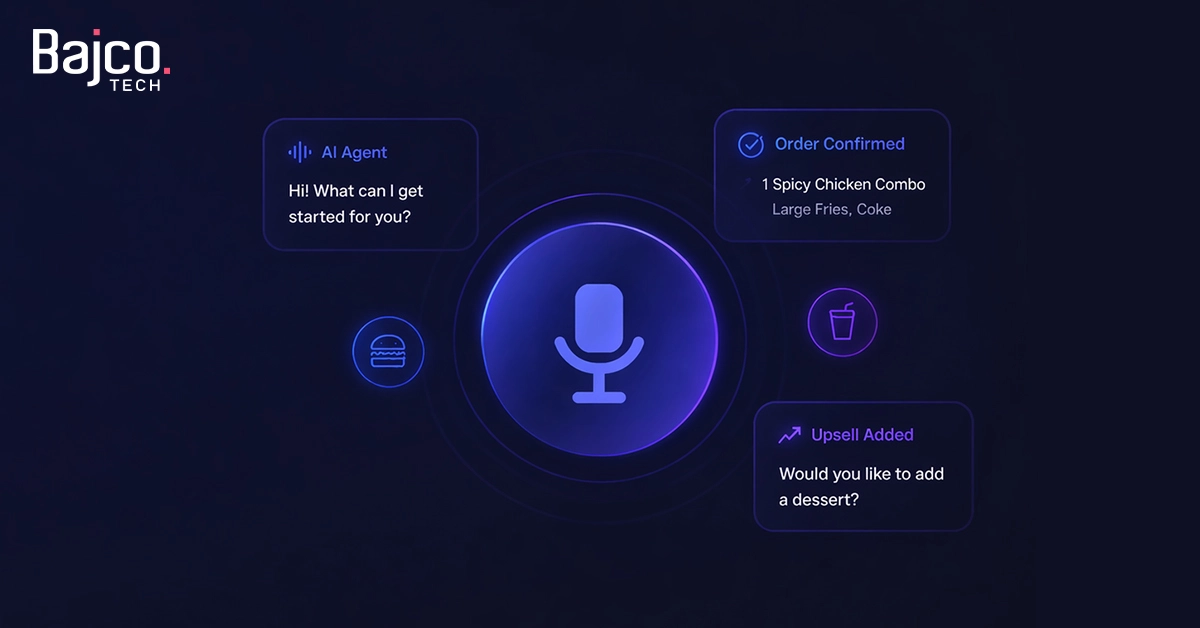
This is the highest-visibility and fastest-scaling use case. Conversational voice AI now handles complete drive-through ordering interactions like greeting guests, capturing orders with complex modifications, confirming back, suggesting add-ons, and handing off to payment.
Yum! Brands (parent of Taco Bell, Pizza Hut, and KFC) announced a partnership with Nvidia to scale AI ordering to 500 locations, building on successful trials where digital orders already represent more than 50% of sales. Wendy’s FreshAI rollout across 500–600 U.S. locations has demonstrated faster service and improved profit margins at company-owned locations. These aren’t small pilots; they are system-wide deployments at some of the largest QSR chains in the world.
The technology is also evolving rapidly. Modern voice AI systems handle multiple accents, bilingual markets (Spanish and English capability is now standard in many platforms), complex combo customizations, and real-time menu changes like 86’d items or limited-time offers.
2. AI-Powered Phone and Call Center Handling
Inbound calls to restaurant locations represent a significant and often invisible operational burden. Calls come in for orders, hours, catering inquiries, complaints, and directions, often during the exact moments when staff are least available to answer them: the lunch rush, the Friday dinner surge, the holiday weekend.
AI-powered call handling routes routine calls automatically, answers common questions instantly, and escalates to a team member only when the situation genuinely requires it. This keeps phone lines from overwhelming already-stretched staff and stops the revenue leak from missed calls that result when guests hang up and call a competitor or order through a third-party platform with a 20–30% commission attached.
3. Smart Routing and Seamless Human Escalation
Not every customer interaction is a good fit for AI, and the best systems know this. Smart routing logic identifies when a guest needs a human based on sentiment signals, issue complexity, or an explicit request, and transfers the conversation without friction. The key is that this escalation feels effortless for the customer, not like being handed off to a different system or put back on hold.
Getting escalation right is what separates an AI-first deployment from one that damages trust. When a frustrated guest asking about a wrong order from yesterday is transferred smoothly to a team member who can see the full interaction history, that’s a service recovery moment. When they’re transferred to a hold queue with no context, that’s a loyalty problem.
4. Operational Intelligence and Analytics
One of AI’s most underappreciated contributions in QSR is the data it generates. AI-powered order taking and call-handling systems produce structured, queryable data on order patterns, peak demand windows, common modifications, upsell acceptance rates, call volume trends, and customer sentiment. This operational intelligence allows operators to make smarter staffing, inventory, and marketing decisions, not just faster interactions.
The Labor Equation: AI as a Teammate, Not a Replacement
No discussion of AI in QSR is complete without addressing the labor question directly. Labor is the industry’s most constrained and most expensive resource. The question on many operators’ team members’ minds is whether AI means fewer jobs.
The more accurate framing is that AI changes which jobs need doing, and how many people are needed for which tasks. When AI handles the high-volume, repetitive interaction layer, answering phones, taking standard orders, and confirming customizations, employees are freed from the most mentally taxing and least-skilled part of their roles. The result is a less overwhelmed team, better deployed against food quality, hospitality, and situations that genuinely require human judgment.
Industry data shows that QSRs using voice AI report lower employee stress and improved team retention metrics in roles that previously required constant headset use. That’s not a side benefit in an industry where turnover can exceed 100% annually; it’s a real operational advantage.
The operators who approach AI as a staffing tool, not a replacement strategy, are the ones seeing the most sustainable results.
How to Implement AI in QSR: A Practical Framework for 2026
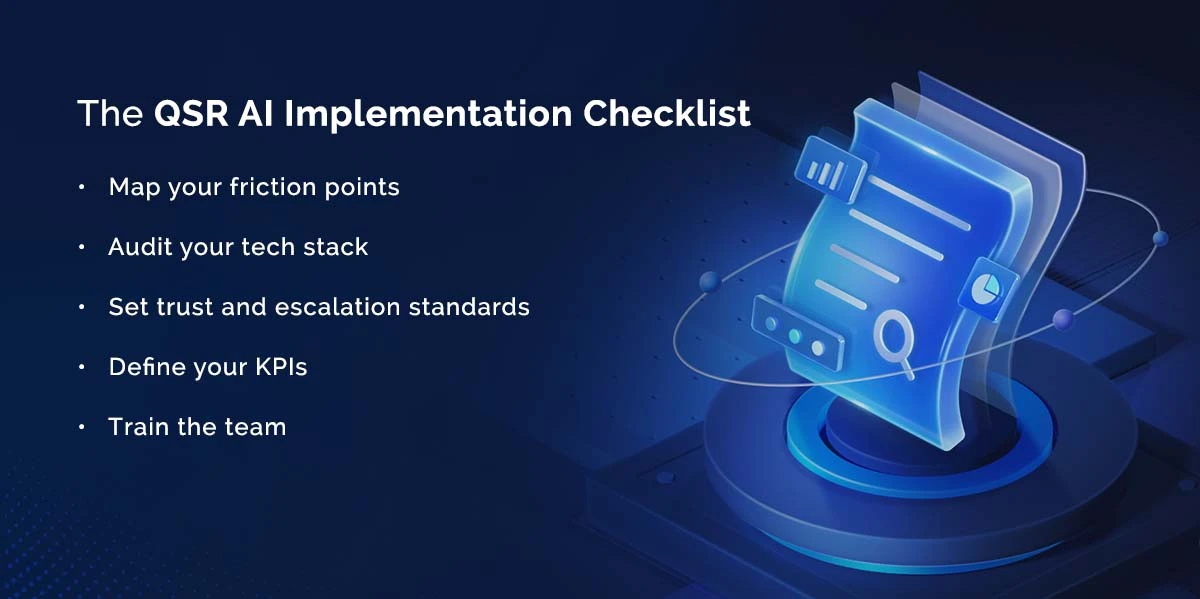
The organizations that will benefit most from AI are not the ones that move fastest; they are the ones that move most intentionally. Here’s a practical starting framework:
Identify Your Friction Points First
Where are orders being lost, delayed, or getting errors? Where is your phone line creating staff overload? Where are upsell opportunities being missed consistently? These are the right places to begin, not with the flashiest technology, but with the highest-cost problems.
Look for Platform Integration, Not Point Solutions
AI only delivers its full value when it integrates with your POS system, ordering platform, loyalty program, and customer data infrastructure. Standalone tools create new data silos rather than solving the ones you already have. Before evaluating any vendor, map your current tech stack and ask specifically how each solution connects to it.
Design for Trust From Day One
Customers need to feel confident that AI will get their order right and that a human is reachable when needed. Systems that clearly confirm orders, handle corrections gracefully, acknowledge when they don’t understand something, and escalate smoothly build that trust over time. Systems that obscure their limitations or create friction on escalation destroy it.
Measure What Matters & Set the Right KPIs
Order accuracy rates, completion rates, average service time, upsell attachment, call abandonment rates, and human intervention frequency are all trackable with AI-powered systems. Set baseline measurements before deployment and track improvement rigorously.
Train Your Team Alongside the Technology
AI works best when your team understands how it complements their role. Train staff on what the system handles, how to manage escalations gracefully, how to intervene when needed, and how to use the time AI creates for higher-value guest interactions. Technology adoption without team alignment consistently underperforms.
What's Coming Next: The QSR AI Landscape Through 2027
The current wave of AI adoption in QSR is primarily focused on the customer-facing interaction layer: drive-throughs, phone lines, and order confirmation. But the trajectory points toward deeper integration across the entire operation.
Industry analysts predict that the next phase will be dominated by what they call “invisible AI” — systems that quietly manage hyper-personalized loyalty rewards, dynamic pricing based on demand and inventory, and real-time labor scheduling without requiring any visible interface at all. Gartner projects that by 2029, agentic AI will autonomously resolve 80% of common customer service issues, cutting operational costs by 30%.
On the ordering side, QSR Magazine predicts that by the end of 2026, at least three major QSR brands will announce direct AI-channel ordering programs, allowing customers to order through AI assistants that interface directly with the restaurant’s POS, bypassing third-party delivery platforms and their 20–30% commission structures entirely.
The brands that establish a solid foundation now, with integrated systems, reliable escalation paths, and team alignment, will be well-positioned to adopt these next-generation capabilities as they mature. The brands that wait will be catching up to a moving target.
Building for What's Next
The trends reshaping QSR customer experience in 2026 will be the table stakes of 2027 and beyond. Voice AI in the drive-through, intelligent call handling, smart escalation, and operational analytics are not future-state technologies, they are live; proven deployments at some of the world’s largest restaurant chains right now.
For operators across the QSR industry, the question is not whether AI will change how guests are served. It already has. The question is whether your operation will lead that change or react to it.
The operators who build deliberately AI-first, human-centered, and grounded in measurable outcomes will define what excellent QSR service looks like in the years ahead.
Why Bajco Technologies Understands This Space
Bajco Technologies isn’t an outside observer to the restaurant industry. It’s built from within it. As part of the Bajco Group, which has served over 3,200 restaurants with technology solutions, owns 275+ Papa John’s locations, and carries more than 30 years of industry experience, we bring a perspective that pure-play SaaS vendors simply can’t match.
Our team has lived through the restaurant challenges firsthand. That operational DNA is what shapes how we build and deploy technology, not for a theoretical restaurant, but for the real one.
Download the Full Operator Guide for Free
This blog post is the long-form version of our operator briefing. If you’d like a concise, printable reference, covering the AI-first framework, real-world QSR use cases, operational insights, and practical guidance for implementation. Download the PDF below.
It’s built to be shared with your management team, used in training sessions, or kept as a quick reference at the location level.